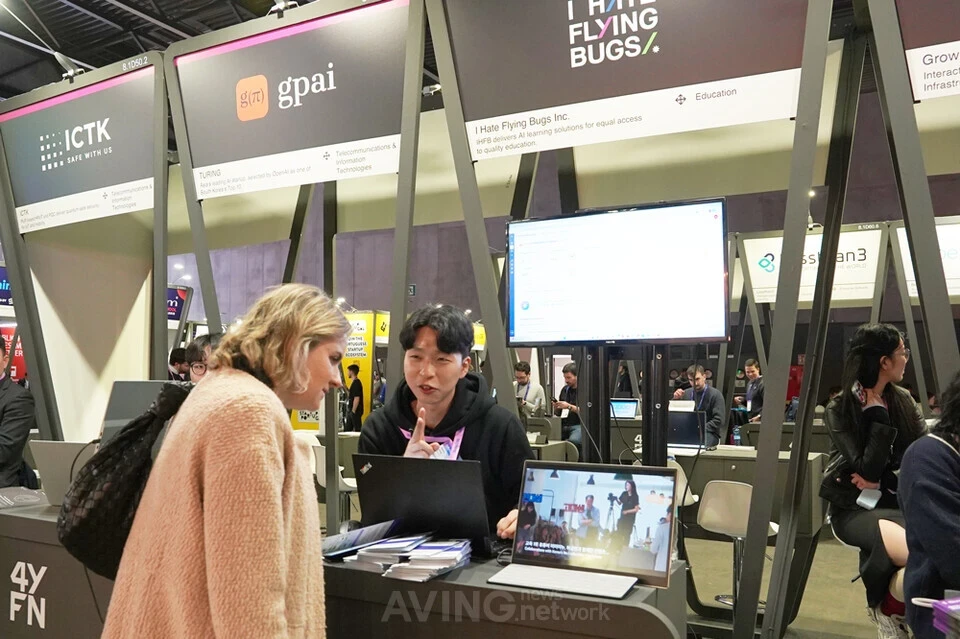
[Forbes Korea] South Korea's AI 50 for 2025
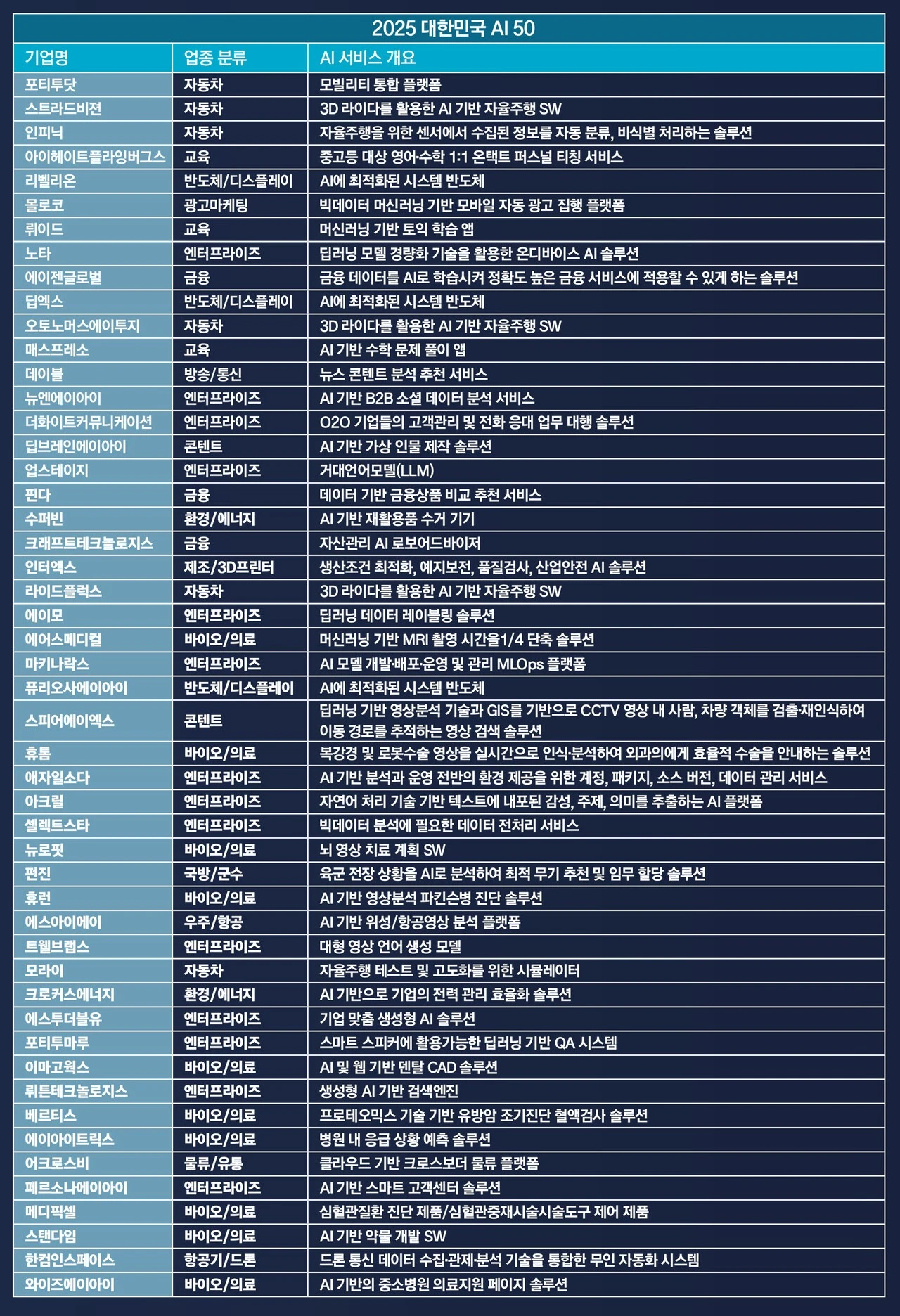
IHFB was featured in Forbes Korea’s “2025 Korea AI 50” list.

Domestic AI Solutions Going Global

The global AI industry is rapidly undergoing a restructuring amid trends toward technological evolution, commercialization, and increased investment. Forbes Korea’s “Korea AI 50” selection highlights the current state of commercialization in the domestic AI industry and identifies and showcases AI companies that are delivering tangible results in the market. This initiative is significant in that it goes beyond merely evaluating technological capabilities; by selecting companies with proven business performance and growth potential, it aims to foster a virtuous cycle within the domestic AI ecosystem and strengthen global competitiveness. Forbes Korea focused on companies driving “real change and innovation” in the AI industry by using metrics that most objectively reflect the commercialization of AI technology and its actual market value.
※ Methodology – Korean startups and mid-sized companies were identified from The VC’s corporate information database based on the inclusion of the keyword “artificial intelligence” in their descriptions of core technologies and products. A total of 924 companies were selected as initial candidates and then filtered according to selection criteria, such as companies whose services or products were “under development” or those lacking information on evaluation metrics. The number of registered patents, amount of investment secured, number of employees, and revenue (as of 2024) were used as evaluation metrics for the candidate companies.
To focus on AI technology validation and market potential, greater weight was assigned to the number of registered patents and the amount of investment secured. Based on the resulting evaluation index, the recent business performance, management maturity, and global market potential of the candidates were reviewed, and 50 companies were ultimately selected as the “Korea AI 50.”
FortyTwo.dot *NEW
CEO: Song Chang-hyun
Number of Registered Patents: 211
Total Investment Raised: 576.7 billion won
Number of Employees: 604
Revenue: 17.3 billion won
FortyTwo.dot was founded six years ago by CEO Song Chang-hyun, former Chief Technology Officer (CTO) of Naver and former CEO of Naver Labs. FortyTwoDot has focused on developing “Autonomous Transportation-as-a-Service (TaaS),” but starting this year, it has temporarily set aside services related to autonomous vehicles to develop “FaceCar,” an AI software-defined vehicle (SDV) capable of autonomous driving through self-learning. FortyTwoDot has been building its in-house AI capabilities since 2022, starting with a voice command system called “Edis.” This system was first applied to the Kia Niro Plus, Kia’s first purpose-built electric vehicle. Hyundai and Kia have begun collaborating with FortyTwo.dot to integrate the AI assistant into key electric vehicles such as the Kia EV3 and the Hyundai Ioniq 9. Additionally, FortyTwo.dot plans to participate in projects to build its own integrated vehicle-hailing platforms in locations such as Doha, Qatar, and Hwaseong, Gyeonggi Province.
StradVision
CEO: Kim Jun-hwan
Number of Registered Patents: 160
Total Investment Raised: 193.8 billion won
Number of Employees: 246
Revenue: 11.5 billion won
StradVision is a startup that developed “SVNet,” an AI-based image recognition software. StradVision’s deep learning-based vision recognition technology continues to show steady growth. In 2024 alone, StradVision’s AI vision recognition software “SVNet” was deployed in 1.67 million vehicles worldwide, bringing the cumulative commercial production volume to over 3 million units. StradVision is strengthening its position as a key partner in Advanced Driver Assistance Systems (ADAS) and autonomous driving technology. Starting in 2025, StradVision is expanding its collaboration with major automakers in the Chinese, European, Japanese, South Korean, and North American markets.
Infinic
CEOs: Park Jun-hyung, Choi Cheol-kyu Number of Registered Patents: 121 Total Investment Raised: 33.3 billion won Number of Employees: 365 Revenue: 25 billion won
Infinic is a company specializing in AI-related data collection and processing, having entered this business in earnest in 2016. In 2019, it established an AI research institute and developed its own data processing and algorithm development systems. Currently, it sells autonomous driving-related data to global companies such as Hyundai Motor Group. This year, the company has identified the defense sector as a new growth area and plans to build an AI platform for securing, producing, and applying military data. This is based on a paper recently published by Infinic in the SCI(E)-indexed international academic journal IEEE Access. The paper describes a model that detects multiple human heads captured in video by treating them as square objects centered on their respective centers; this method provides more accurate location determination than existing approaches, making it easier to assess overcrowded areas.
I Hate Flying Bugs
CEO: Park Chan-yong
Number of Registered Patents: 3
Total Investment Raised: 63.5 billion won
Number of Employees: 530
Revenue: 37.6 billion won
I Hate Flying Bugs is an education SaaS company that provides AI-based, personalized learning management services. It is best known as the operator of “Mil-dang PT,” an AI-based online tutoring service that provides English and math instruction for middle and high school students. I Hate Flying Bugs offers a fully integrated educational environment essential for digital education through its proprietary, comprehensive technology system. Through this, the company operates personalized learning services. Last November, it passed the certification process for AI digital textbooks (AI DT), thereby completing its SaaS model. Recently, the company has adopted generative AI and is pushing forward with the introduction of “Teacher AI,” which goes beyond a simple AI chatbot to proactively intervene in the learning process through comprehensive judgment. The goal is to fully implement Proactive Multi-Agent AI by the end of this year.
Source: Forbes Korea (https://www.forbeskorea.co.kr)