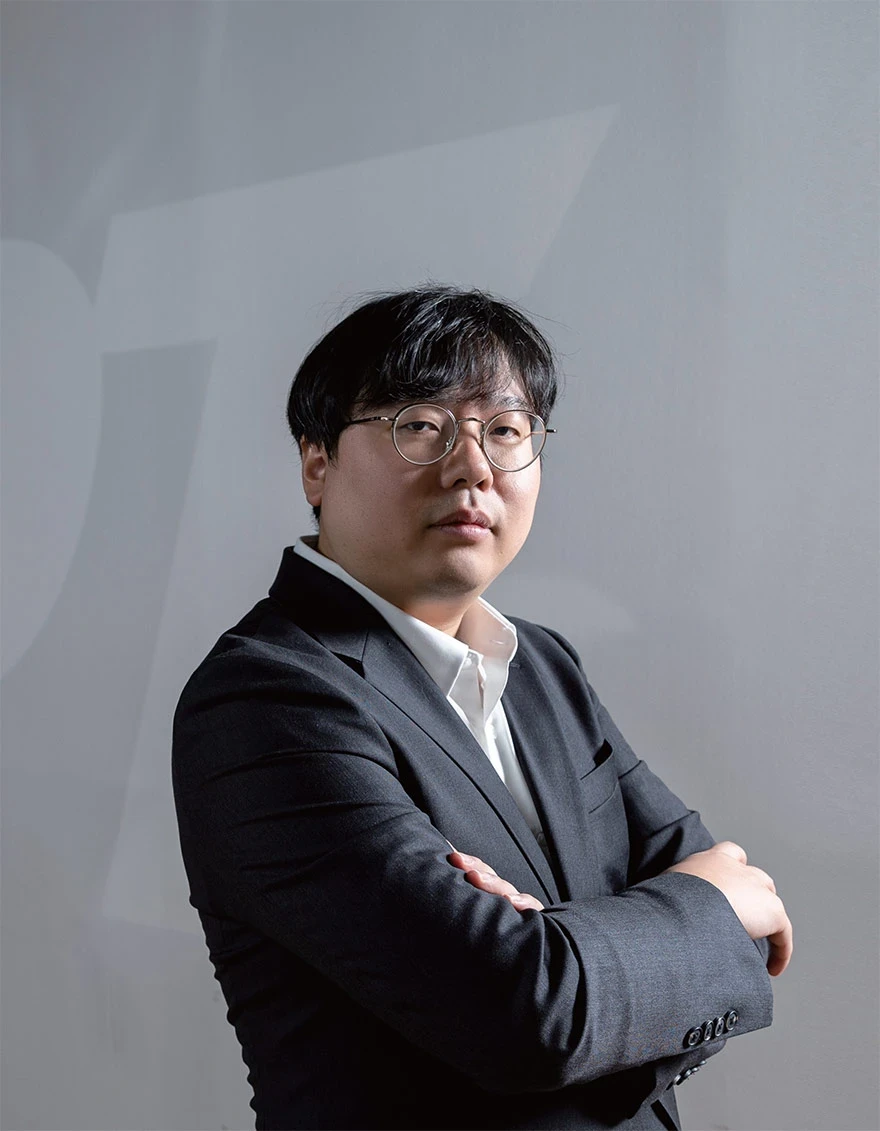
[2024 Korea AI 50] Park Chan-yong, CEO of I Hate Flying Bugs
In this Forbes interview, we introduce IHFB’s educational philosophy and digital education initiatives.

Equality of Access to High-Quality Education
A child’s education is the top priority for many people. The educational environment influences real estate values, and the educational gap driven by parental economic status continues to be a social issue. I HATE FLYING BUGS, selected as one of the “2024 Korea AI 50” companies, is an edtech firm that seeks to achieve equality of access to education by integrating education and technology.
When it’s time for elementary school students to go home, the area in front of the school becomes crowded with cram school buses, parents, and students all mingling together. As soon as the children step out of the school gates, they hurry to board their respective cram school buses without even having a chance to greet their parents. Even in the early grades of elementary school, taking two or three private lessons—such as English, math, science, music, and taekwondo—has become the norm.
At a series of seminars on current educational issues hosted last January by the Korean Peninsula Advancement Foundation and others, Yang Jeong-ho, a professor in the Department of Education at Sungkyunkwan University, revealed that private education expenses totaled approximately 26 trillion won in 2022. The majority of these expenses are accounted for by in-person cram schools and private tutoring. Park Chan-yong, CEO of I Hate Flying Bugs, whom I met at Park One in Yeouido, Seoul, on April 11, explained, “Offline academies and private tutoring account for 91% of the education market, while the online education market makes up 5%.”
Why is the online education market so underdeveloped? Unlike offline academies, where students and teachers meet face-to-face to manage progress, it is difficult to provide personalized support for individual students. Overseas, there has been large-scale investment in “Adaptive Learning,” which provides customized curricula optimized not only for content and methods but also for assessment methods and difficulty levels, based on learner preferences and learning analytics data. While the goal was to improve educational effectiveness and learner satisfaction, the results were not promising. CEO Park pointed out, “Only a tiny fraction of students actually prefer to study. The fact that these companies have failed one after another proves that even when companies provided personalized content, the students using the service simply didn’t study.”
CEO Park graduated from Yonsei University’s Department of Mechanical Engineering and entered the startup scene in 2012. While monitoring the education market, he observed that private tutoring still dominated the private education sector. He came up with the idea of combining adaptive learning with direct human oversight of users’ learning progress. He proposed a business model that builds an AI-based educational system, analyzes learning data accumulated online, and provides personalized content alongside direct human supervision.
CEO Park explained that AI-based “Real-Time Learning Analytics” is fully implemented within the Education Platform as a Service (EPaaS). EPaaS consists of four management systems: CMS (Content Management System), TMS (Teaching Management System), LMS (Learning Management System), and CRM (Customer Relationship Management). Content creation, curriculum design, and learning records are handled by the CMS; real-time learning monitoring and feed delivery by the TMS; learning reports and review by the LMS; and payment, sales, and academic record management by the CRM. Content created in the CMS is used by teachers to manage learners via the TMS, while learners study using the LMS. This enables the accumulation of data and the expansion of business areas all within a single platform.
iHateFlyingBugs’ business areas are divided into two categories: private education and public education learning management. In private education, there are “Mil-dang PT” services for individual learners and for private academies. The personal version of Mil-Dang PT matches learners one-on-one with I Hate Flying Bugs teachers to facilitate learning management. The academy-based content is currently being provided in partnership with leading educational companies such as Megastudy and NE Nungryul. In addition, the company has launched “School PT” for public education learning management.
Real-time monitoring and data-driven, personalized content delivery

Why is monitoring important in learning?
There are two key benefits to monitoring during tutoring sessions. First, it encourages the learner to study. The presence or absence of an observer has a Hawthorne effect on study efficiency and outcomes. When a teacher is watching, the learner has no choice but to focus on studying, and learning efficiency increases compared to studying alone. Second, it provides immediate answers to the learner’s questions. If the learner encounters something they don’t understand while studying, they can ask a question, gain immediate understanding, and move on.
An analysis of English tutoring methods revealed that monitoring—such as vocabulary quizzes and practice problems—accounted for 41% of a two-hour tutoring session. AI-based “Real-Time Learning Analytics” replicates the monitoring effects of tutoring, while “Study Activity (SA),” the smallest learning unit within Mil-Dang PT, replaces traditional lectures. Drawing on over 10 years of experience in this field, we’ve transformed existing textbooks into “Study Activities,” packing millions of pieces of knowledge onto a single tablet. These activities can be described as personalized content summaries tailored just for you. Thanks to technologies like Learning Analytics and Study Activities, 89% of a teacher’s workload has been automated.
How does AI monitoring work?
Teachers observe learners as they study and respond to their questions within three minutes—a response rate of 90%. They can track how many questions a learner got wrong, how long it took to solve a problem, and review incorrect answers. For example, when studying English, teachers can determine whether a learner couldn’t solve a problem because they didn’t know a word or because they didn’t understand the sentence structure. Teachers can also use “Real-Time Learning Analytics” to monitor the problem-solving process in real time. Based on learner data, teachers identify areas of weakness and provide additional content to address them or recommend learning paths to help improve proficiency.
How does AI-based content recommendation work?
It assesses the learner’s progress and recommends AI-based content. In addition to multiple-choice questions, the AI automatically grades open-ended questions as well. The service provides a summary analysis of correct answer rates from last week and the most recent period, and even tracks the learner’s mouse movements. This combination of technologies enables a single teacher to manage multiple learners, creating a sustainable learning management model that ensures 100% supervision for six hours each week. It can be described as a structure where learners, learning management, and content are all interconnected.
Can online learning be made mandatory?
The challenge that educational services must address is motivating learners to study. The Mil-dang PT monitoring system allows administrators to check not only attendance but also users’ learning status and progress at a glance. Through periodic counseling, it manages learners’ motivation and emotional well-being to foster a closer relationship. While the course completion rate at typical online course providers is only 7–8%, we boast a 95% completion rate thanks to our seamless, one-on-one personalized support. In fact, we’ve even achieved actual improvements in test scores. Educational effectiveness cannot rely solely on technology. We believe that the value of technology shines only when it coexists with people. In this way, we’re using technology to achieve high-quality educational equity.
How are Mil-Dang PT instructors selected?
I Hate Flying Bugs instructors are not college students or casual part-timers like those found in typical private tutoring; they are full-time teachers who have passed a rigorous selection process with a 9% acceptance rate. We have currently hired about 300 instructors, and after selection, they undergo a systematic orientation program for a set period. We provide various training programs, including ongoing performance management and motivation, ensuring our instructors are just as competitive as those at typical private tutoring services or cram schools.
I want to take the lead in digital education innovation
Starting in 2025, AI-powered digital textbooks are scheduled to be introduced in select grades at elementary, middle, and high schools. How is I Hate Flying Bugs responding to the trend toward digital innovation in public education?
Digital education innovation is one of the Ministry of Education’s three major educational reform initiatives, and the rollout of AI-powered digital textbooks is underway. With a cumulative user base of 200,000 and 1.8 billion data points of learning data, I Hate Flying Bugs was selected in 2023 as a contractor for the AI-powered digital textbook research project for secondary mathematics by the Korea Education and Research Information Service (KERIS), an affiliate of the Ministry of Education. AI digital textbooks are textbooks equipped with a variety of learning materials and support features—utilizing intelligent information technologies, including AI—to provide diverse, personalized learning opportunities tailored to each learner’s individual abilities and proficiency levels. By leveraging data collected from and managed for each learner, these textbooks aim to provide personalized learning recommendations and relevant information to students, teachers, and parents. The goal is to reduce educational disparities among students through the use of edtech and to realize personalized education that nurtures everyone into talented individuals. I Hate Flying Bugs also aims to contribute to achieving this goal.
Is one-on-one management possible in the public education market, just as it is in private tutoring?
Assuming an offline class has 30 to 40 students, it is difficult for a teacher to check individually who is paying attention in class. By using School PT, school teachers can provide one-to-many personalized learning management. They can explain concepts students don’t understand in detail and move quickly through material students already know. Teachers provide study activities based on digital textbooks. We believed that adaptive learning with personalized content would be possible even in public education.
There may be some criticism that AI will replace teachers.
iHateFlyingBugs’ mission is “equality of access to high-quality education.” In the field of education, it’s best to understand AI not as a replacement for teachers, but as a tool that enhances their capabilities. We’re not building robots to replace teachers; rather, we’re developing a suit—like the one in the movie Iron Man—that teachers can wear. Through technology, we’re making a crucial contribution to creating equality of access to high-quality education.
Why is the industry paying attention to I Hate Flying Bugs?
We founded the company in 2012 and began with vocabulary study through “Mil-dang English” in 2013. In 2016, we entered the private academy and school markets using the educational LMS—the result of the first phase of Mil-Dang English’s development—and in 2017, with the second phase of Mil-Dang English’s development, we launched a messenger-based, remote management service for civil service exam candidates. In 2019, Mil-Dang English entered the one-on-one remote learning management market for middle and high school students. We are not a company that sprang up overnight in just one or two years, but one that has grown steadily, taking each step one at a time. Our cumulative investment raised amounts to 65.9 billion won, and in 2023, we were selected as a “Pre-Unicorn Company” by the Ministry of SMEs and Startups. We truly feel the high expectations society has placed on us. We want to rise to those expectations and take a leap forward.
The company appears to offer excellent employee benefits, as evidenced by its recognition as a “Work-Life Balance Practice Company” by the Ministry of Employment and Labor in 2021 and its receipt of the “Minister of Trade, Industry and Energy Award” at the 2023 Happy SME Jobs Awards.
Given that our workforce consists largely of people in their 20s and 30s, the employees themselves are shaping the company culture. A prime example is our in-house social clubs. Posters on the office walls advertise recruitment for various employee clubs—such as hiking, exploring local restaurants, and digital art—each reflecting the unique personalities of the members. We’ve implemented a flexible work schedule, and the spot in our office with the best view serves as both a break room and a cafeteria for employees. Unlike other AI companies, the education sector is an area that requires a more nuanced, human touch. After carefully crafting a supportive work environment for our employees, we saw significant revenue growth and a noticeable decrease in turnover. In the early days of the company, there were only five employees, including myself, but as of April 2024, we’ve grown to 533 employees.
What are your plans for international expansion?
Currently, our company is interested in both B2G (Business to Government) and B2C (Business to Consumer) markets. We’ve even received inquiries from overseas publishers. This year, we’re focusing all our efforts on domestic digital textbooks, and we expect to begin actively expanding into overseas markets starting in 2025.
Source: Forbes Korea (https://www.forbeskorea.co.kr)