[The Electronic Times] Bett 2024: Korean EdTech Shines in the UK… AI Textbooks Make Their Debut
Here’s an introduction to South Korea’s AI-powered digital textbooks and edtech technologies, which were unveiled at Bett 2024 in the UK.

Keeping pace with advancements in artificial intelligence (AI) technology, South Korean edtech companies are making inroads into the global market. Having announced plans to introduce the world’s first AI digital textbooks in 2025, the Ministry of Education has accelerated its efforts by unveiling a prototype. This achievement comes as the Ministry of Education moves full steam ahead with its major educational transformation.
On the 24th (local time), the Ministry of Education unveiled a prototype of its AI digital textbook at “BETT UK 2024” (hereinafter referred to as “BETT Show”), the world’s largest edtech exhibition, held in London, England.
“One Year Before Rollout”: AI Digital Textbook Prototype Unveiled

BETSHO, the world’s largest edtech expo, is a major educational technology trade show that attracts more than 60,000 visitors annually and features over 1,200 edtech companies from 123 countries.
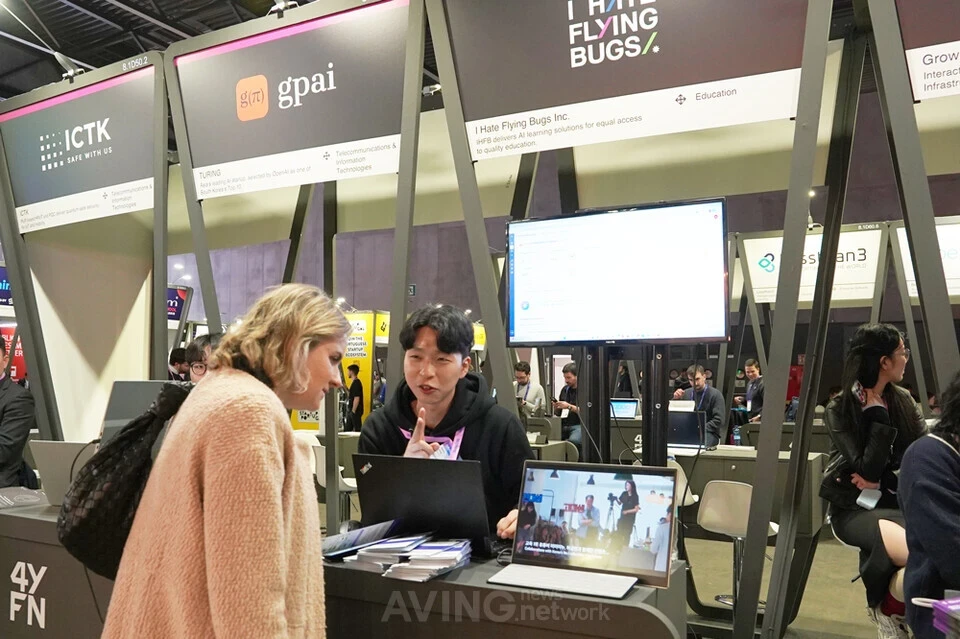
The South Korean Ministry of Education, in collaboration with 14 Korean companies and institutions, set up a joint exhibition booth to showcase AI digital textbook prototypes provided by developers. This marks the first time the Ministry of Education has opened a booth and participated in BETSHO.
AI digital textbooks are being promoted to realize personalized education based on technological advancements, as strengthening the capabilities of individual students becomes increasingly important amid a declining school-age population. With full-scale implementation in public schools scheduled to begin in 2025, AI digital textbooks will be used in mathematics, English, and computer science classes starting with third and fourth graders in elementary school, as well as first-year middle and high school students.
With just over a year remaining before the introduction of AI digital textbooks, the Ministry has unveiled prototypes to be used for teacher training.
The prototype for the math curriculum was developed by the edtech company “I Hate Flying Bugs” using its “SchoolPT” platform. It allows teachers to immediately review students’ problem-solving progress, identify which problems were answered incorrectly, and provide additional instruction on areas of weakness. For students capable of advanced learning, the system can provide more challenging problems. Key concepts that must be understood before moving on in each unit are visualized in diagrams, making areas requiring further study clearly visible.
The AI-powered digital English textbook was created by Ellis Group. It features a dashboard that uses students’ learning data to graphically display their likelihood of completing each lesson, helping educators identify students who need assistance, as well as an analytics system that analyzes achievement levels across English learning domains—such as vocabulary and sentences—and presents the results in natural language. By managing individual student data, the system can receive AI-generated recommendations for content deemed lacking for each student and provide supplementary learning accordingly.
Big Tech Is Making Inroads into Education… K-EdTech Is Also Gaining Ground
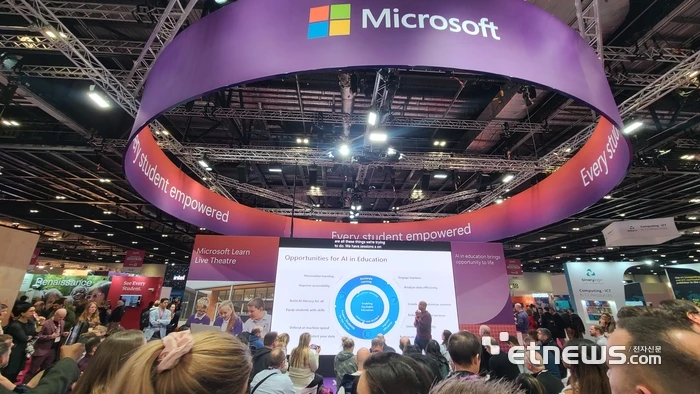
Global tech companies made a strong showing. Microsoft (MS), Meta, and Google set up large exhibition booths at the BET Show to showcase the future of education integrated with technology.
Microsoft unveiled an app version of Reading Coach, which was first introduced on Teams. When learners use Reading Coach to select characters and settings, the app presents a story generated by AI. The company also demonstrated how to use generative AI to create grading criteria and develop lesson modules. It presented ways for educators to utilize the AI chatbot “Copilot.”
Meta highlighted the “Quest 3,” unveiled late last year, to demonstrate how mixed reality (MR) can be integrated into educational settings. The company showcased how MR devices can be used in education, such as conducting experiments—like measuring the pH concentration of a solution—while wearing the Meta Quest 3.
Google introduced ways to boost productivity and creativity in the classroom using the generative AI “Duet AI.” They focused on showcasing a workspace designed for ease of use, which analyzes students’ learning activities to assess their proficiency levels.
Hardware companies such as ASUS, Lenovo, MediaTek, Hewlett-Packard (HP), and ViewSonic also exhibited electronic devices with the latest specifications and emphasized that hardware is crucial for creating an optimal environment for utilizing edtech. Intel highlighted the performance of its AI computers equipped with NPUs, demonstrating features such as the ability to generate images based on user input even in offline environments.
Korean edtech companies also showcased a variety of hardware and software at BetShow. Ice Cream Media participated in this year’s exhibition with its largest booth to date, introducing “EduBank AI,” a multimedia curation platform, and “Ice Cream S,” an educational content platform.