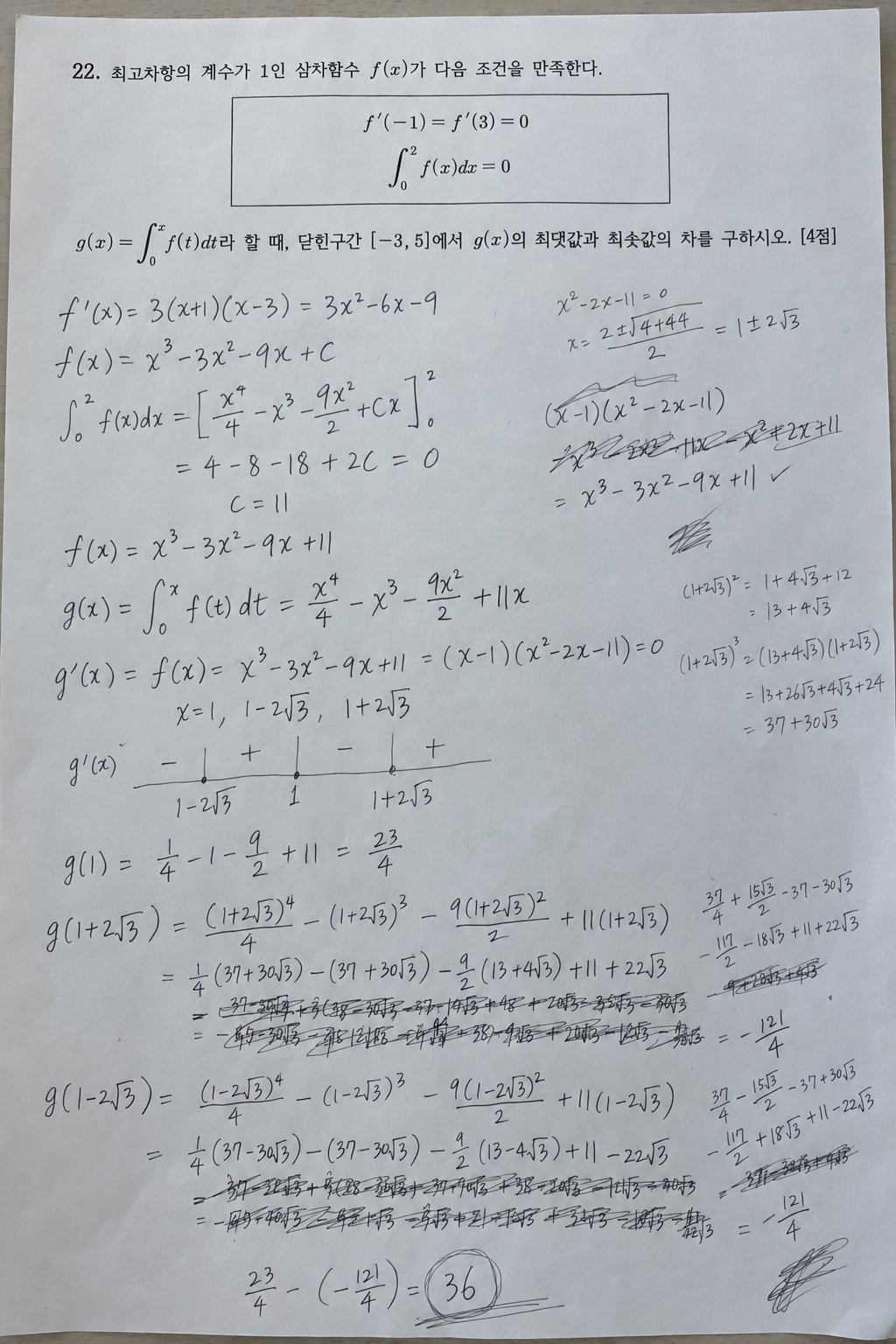
Local extrema were compared, but the closed interval's endpoints were not checked.
Evidence Maximum and minimum values were determined without comparing g(−3) and g(5).


Precise AI diagnosis of handwritten solutions
MPD (Math Precision Diagnosis) analyzes every handwritten solution with AI. Beyond right or wrong, it identifies conceptual gaps, error types, and habits to support targeted feedback.
Precise AI diagnosis of handwritten solutions
No new dedicated device is required. Use smartphone photos, scanned PDFs, or tablet handwriting. A single PDF containing several students' work can be separated, matched to questions, and turned into individual reports automatically.
 Scan
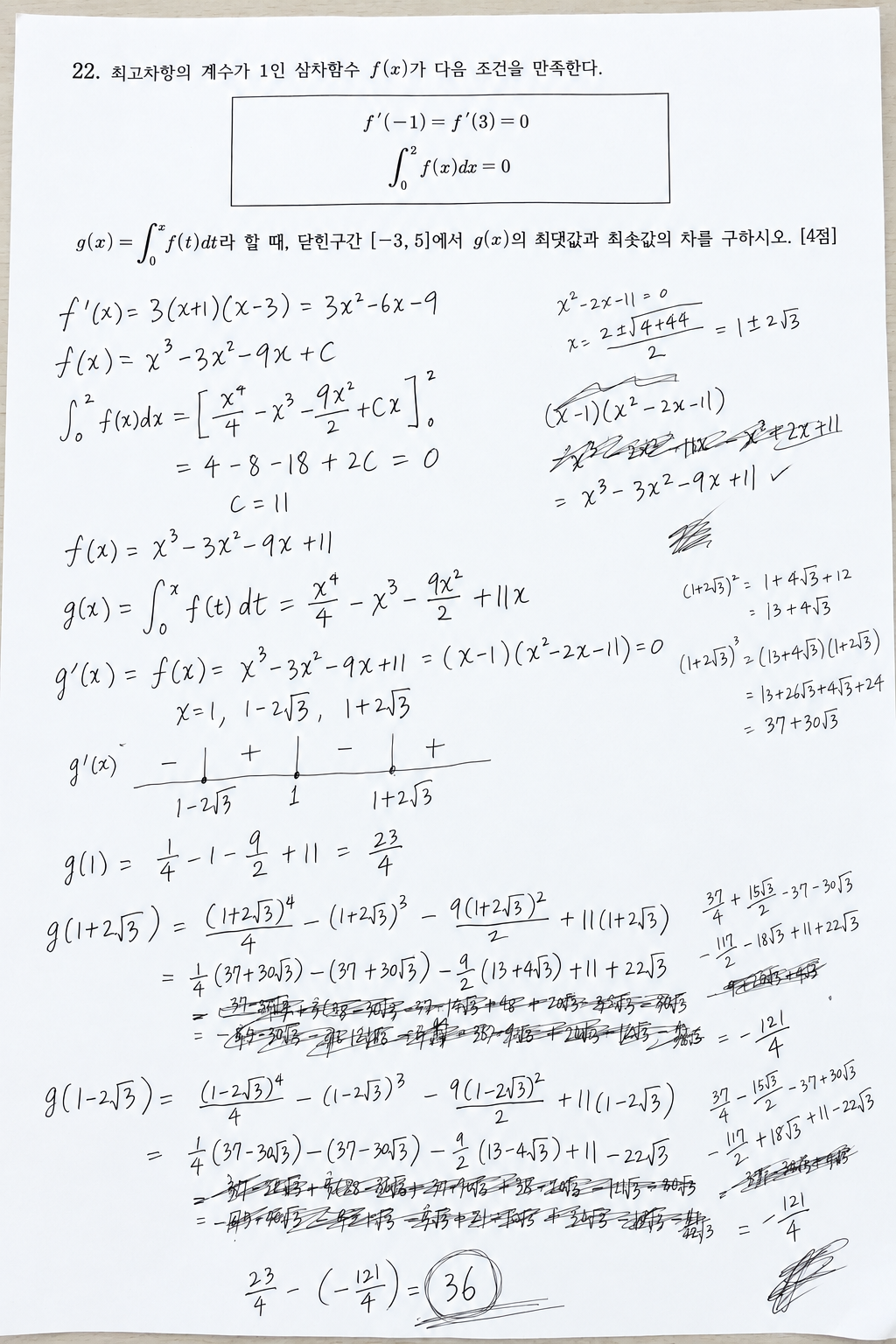
ScanThe solution uses derivative and integral conditions to obtain the function and the correct answer, 36. However, it omits comparison of the interval endpoints and contains an error in expanding a fourth-power term. Review the calculations and reasoning for maximum and minimum values, not only the final answer.
Local extrema were compared, but the closed interval's endpoints were not checked.
Evidence Maximum and minimum values were determined without comparing g(−3) and g(5).
The solution expands radical expressions directly without using symmetry.
Evidence Substituting u=x−1 simplifies the expression into fourth- and second-power terms.
The difference was calculated after finding local extrema, without checking both endpoints.
Evidence Compare all local extrema and boundary values before deciding the maximum and minimum.
A cubed expansion value was substituted into a fourth-power term.
Evidence The work uses 37±30√3 for (1±2√3)⁴. The correct value is 217±104√3.
Repeated lengthy expansions and substitutions made the calculation more complicated.
Evidence The same expression was expanded several times; substitution could reduce the work.
The actual solving time cannot be determined from this handwritten work alone.
Evidence The photo does not record time spent on each problem.
Also compare the endpoint values g(−3)=g(5)=−105/4. Substituting u=x−1 gives g(x)=u⁴/4−6u²+23/4, reducing the calculations.
This is an illustrative demonstration. The diagnosis is authored for the example solution and is not an actual MPD analysis result.
Explore MPD reports
Students with the same score may need different guidance: one missed a concept, another made a calculation error. Actual reports show what to teach next, from individual mistakes to recurring habits.
Analysis at each stage
Based on George Pólya's problem-solving framework, MPD analyzes understanding, planning, and execution. Even advanced students who understand a problem can examine calculation habits and inefficient approaches in execution.
Review how the student identified information, conditions, and the target quantity.
Examine the conditions used, method chosen, and sequence planned.
Check calculation accuracy, unnecessary work, indirect approaches, and final review.
How MPD changes feedback
Add solution diagnosis to existing lessons and assessments to explain what scores alone cannot. Students gain evidence to reflect on their reasoning, and learning centers have more room for deeper guidance.
Start with the student's own writing to identify where they got stuck and what to change.
Review all students and all problems against consistent criteria, then focus on lessons and in-depth guidance.
Introducing MPD
Explore MPD’s precise math diagnosis, from handwritten solution analysis to diagnostic reports and the AI tutor.
Before you get started
MPD
Discuss how MPD can fit your lessons, questions, and operating approach.